Restaurants & food service
Grease and wet food waste. Weekly or every-two-weeks service is common, especially April through October.
Dumpster and enclosure cleaning for restaurants, plazas, offices, apartments, HOAs and medical offices in Palm Beach & Martin County. Call for a commercial quote: (561) 954-3627.
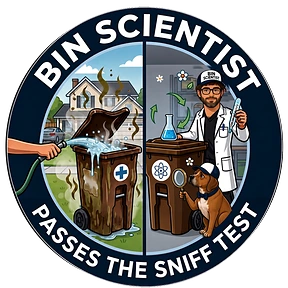
Jax and Oliver, our official sniff tester, show how we clean: an enzyme cleaner, a hot rinse capped at 128°F and an ozone finish.
Grease and wet food waste. Weekly or every-two-weeks service is common, especially April through October.
Lighter, drier waste. Monthly service suits most properties; busy shared enclosures do better every two weeks.
Shared enclosures get daily use from many residents. Every two weeks or monthly, plus a pad wash.
Clubhouse and amenity dumpsters, monthly or quarterly. Curbside carts for 25+ homes go on our HOA plan.
Regular trash dumpsters only. We don’t handle regulated biomedical waste or its containers.
Pests need food, water and shelter, and a neglected dumpster area can supply all three.
The CDC says rodents can spread diseases such as leptospirosis and salmonellosis through droppings, urine, saliva and bites, and that the best way to keep them away is to remove their food, water and shelter. Health officials call sanitation “the single most important factor for rodent control.”
CDC: Controlling wild rodent infestations DC Health: dumpsters and rodent problemsIn Florida, garbage facilities and piles of organic debris give American cockroaches food, water and hiding places. At least 22 species of disease-causing bacteria, viruses, fungi and protozoa have been found on field-collected American cockroaches.
UF/IFAS EDIS: American cockroach (EENY-141)More than 100 pathogens are associated with the house fly, which picks them up from garbage and carries them to food. UF/IFAS entomologists advise tight lids and regular dumpster cleaning.
UF/IFAS EDIS: House fly (EENY-048)Rain can wash grease, oil and trash from lots and alleys into storm drains and out to local waterways. The EPA advises keeping lids closed so rain doesn’t wash waste into storm drains.
U.S. EPA: Stormwater Smart, Restaurants (PDF)OSHA requires walking-working surfaces to be kept clean and free of hazards such as leaks and spills, including the path staff walk to the dumpster. The EPA notes regular washing removes sticky buildup that draws flies, wasps and cockroaches.
OSHA 29 CFR 1910.22: Walking-working surfaces U.S. EPA: Reduce pests by properly handling waste (PDF)Florida’s Division of Hotels and Restaurants (DBPR) inspects licensed food service establishments under the 2017 FDA Food Code, with 1 to 4 unannounced inspections a year plus visits after complaints. The Food Code calls for receptacles to be cleaned often enough that soil doesn’t build up and they don’t attract insects and rodents. Here is DBPR’s own violation wording:
| Code | DBPR violation wording |
|---|---|
| 33-10-4 | “Dumpster not clean.” Inside/outside of dumpster not clean. |
| 33-16-4 | “Dumpster lid open.” |
| 33-11-4 | “Drain plug missing.” Missing drain plug at dumpster. |
| 33-14-4 | “Dumpster overflowing.” |
| 33-19-4 | “Garbage on ground/pad around dumpster.” |
| 33-20-4 | “Grease on ground/pad around grease receptacle.” |
| 28-15-4 | “Dumpster leaking liquid waste.” Liquid waste leakage from dumpster onto ground/dumpster pad. |
| 28-03-4 | “Waste receptacle/floor mat/hood filter cleaned in a manner that allows the waste cleaning water to drain onto ground.” |
| 35A | “Rodent droppings. Live roaches. Live rodent.” High Priority pest violations. |
Inspectors can issue a warning with a deadline; uncorrected or repeated violations can lead to an Administrative Complaint and penalties. Inspection results are public.
DBPR Division of Hotels and Restaurants: Food Service Violations list (PDF) DBPR Hotels and Restaurants: Inspections FDA Food Code 2017, as adopted by Florida DBPR (PDF)Hosing out a dumpster and letting greasy water run across the pad, the parking lot or into a storm drain can break more than one rule. Restaurant inspectors cite it as 28-03-4. Not every rinse gets cited, but if it does, these are the published maximums:
| Who enforces | Fine amounts on the books |
|---|---|
| Florida DBPR (licensed restaurants) | Standard Basic-violation fines run $150–$300 for a 1st offense, $250–$500 for a 2nd and $350–$1,000 and/or license suspension for a 3rd. Under s. 509.261, fines can go up to $1,000 per offense. DBPR Hotels and Restaurants: Inspections Florida Statutes s. 509.261 |
| Palm Beach County (unincorporated) | Under the county stormwater pollution ordinance (Ord. 2004-050), fines can reach $1,000 per day for a first violation and $5,000 per day for a repeat. Palm Beach County ULDC Article 10, Enforcement (PDF) |
| City of West Palm Beach | Only stormwater may go into the city’s storm sewer system. Up to $500 per offense and/or up to 60 days in jail; each day is a separate offense. West Palm Beach Code §1-13, General penalty |
| Town of Jupiter | Non-stormwater discharges to the town’s stormwater system are banned. Civil fine up to $500 per day. Town of Jupiter Code, Ch. 20, Art. VI |
| Martin County | Illicit discharges to the county storm system are banned (§67.404). Those responsible can pay sampling and cleanup costs plus any county, state or federal fines (§67.408). Florida code boards can fine up to $250 per day ($500 for repeats), or up to $1,000 per day ($5,000 for repeats) where higher limits are adopted. Martin County Code §67.404, Prohibited discharges Martin County Code §67.408 Florida Statutes s. 162.09, Administrative fines |
| Florida DEP | A court can order civil penalties of up to $15,000 per offense, and each day counts as a separate offense. Florida Statutes s. 403.121 |
Florida DEP guidance for mobile washing says wash water must be collected and disposed of properly, not sent down storm drains. Florida DEP: Best practices for mobile vehicle and equipment washing (PDF) Actual penalties depend on the facts, the location and the agency. General information, not legal advice.
Enzyme cleaners are made of proteins, and too much heat breaks them down. One maker of a multi-enzyme cleaner warns that temperatures over 149°F (65°C) can denature enzymes, and a lab-detergent maker says to keep its enzyme wash below 130°F. Very hot washes of 200°F or more are well past those limits, so we keep our rinse at 128°F.
Case Medical SuperNova enzyme cleaner sheet (PDF) Alconox TechNotes: Tergazyme vs. AlconoxWe clean the containers you have. Lids, drain plugs, repairs and pickup schedules are up to your hauler. We don’t pump grease traps or handle regulated medical waste. Inspection results depend on the whole operation and can’t be guaranteed.
Jax will look at your containers and enclosure, then send a written quote with the scope, frequency and price.